
International Robotics Competitions Explained: Pathways for K–12 Students
Updated: Dec 9, 2025
Future Lab Academy Insights
Understanding K–12 Robotics Competitions
Robotics and AI competitions are becoming one of the most powerful ways for students to grow in engineering, problem-solving, teamwork, and confidence. But for many parents, the landscape of k12 robotics competitions can feel overwhelming:
Which competitions are appropriate for beginners?
Which require advanced engineering or coding skills?
Which ones actually help with portfolios or college applications?
This guide breaks down major competitions—WAICY, FLL, VEX, WRO, FCR, and ISEF—in a simple, structured, parent-friendly way. Competitions aren’t just about “winning trophies.” They are structured growth systems that give learning purpose, direction, and motivation.
Why K–12 Robotics Competitions Matter
Robotics competitions transform curiosity into motivation. They turn learning into something students truly care about.
1. Build Strong STEM Portfolios
Competitions naturally produce:
engineering documentation
project presentations
teamwork evidence
demo videos
These strengthen high school and college applications because they show real skills—not test performance.
2. Build Teamwork & Leadership
Students learn:
collaboration and negotiation
sharing responsibilities
communication under pressure
role assignment and accountability
These are lifelong skills.
3. Build Real Engineering Problem-Solving
Students learn to:
debug under time pressure
cope with unclear tasks
iterate quickly
test and refine solutions
It is the closest experience to real engineering available to K–12 students.
WAICY: World Artificial Intelligence Competition for Youth
Best for Grades 3–8 / AI Beginners
WAICY is one of the most accessible AI competitions worldwide. It is ideal for students who are new to:
machine learning
coding
storytelling
creative project development

Why WAICY Works for Beginners
✔ Flexible project types
✔ No hardware required
✔ Allows art, storytelling, or research
✔ Gentle introduction to AI concepts
✔ Portfolio-friendly
WAICY builds confidence in both AI thinking and communication.
Students collaborate on AI-generated art projects during the World Artificial Intelligence Competition for Youth (WAICY), exploring creativity through advanced machine learning tools.
FLL: First LEGO League
Best for Grades 3–8 / LEGO Spike or EV3 Learners
FLL is a perfect entry point for younger students entering robotics competitions. It emphasizes:
LEGO Spike Prime or EV3 programming
teamwork and core values
themed engineering challenges
research project development
Why Parents Love FLL
✔ Highly supportive environment✔ Strong teamwork culture✔ Great for beginners✔ Accessible introduction to robotics strategy
Team Sprockets erupts in celebration after winning at the FIRST LEGO League competition, surrounded by cheering families and an electrifying crowd.
FLL is often the “starter competition” for elementary and early middle school students.
VEX Robotics (IQ & V5)
Best for Grades 4–12 / Students Ready for Challenge
VEX is considered the most rigorous and competitive robotics program globally.
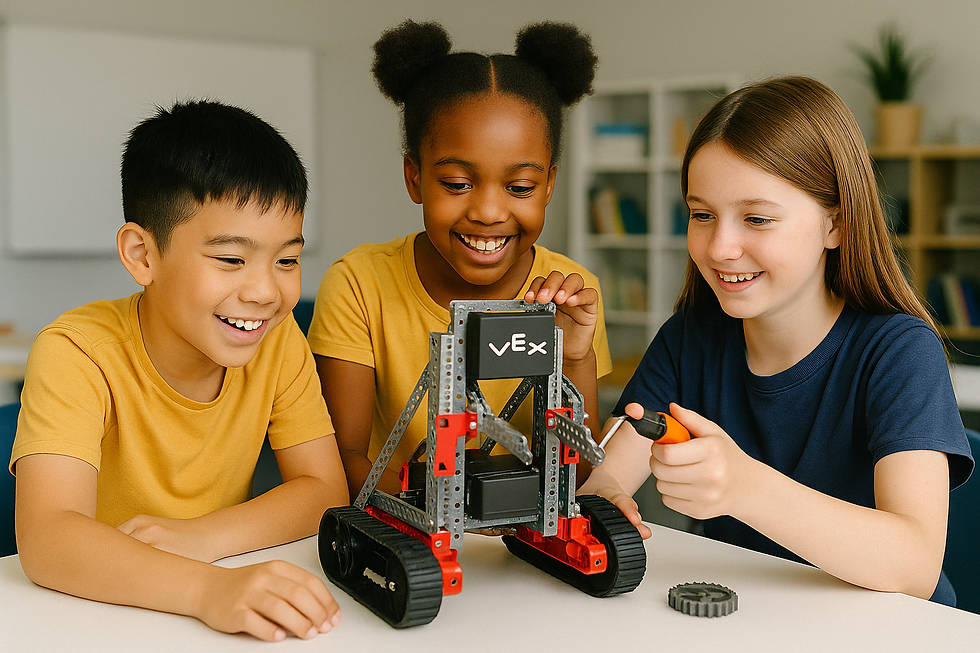
VEX IQ (Elementary–Middle School)
Plastic components
Block or Python coding
Strategy + engineering challenges
VEX V5 (Middle–High School)
Metal construction
Advanced engineering design
Python or C++
Tournament-style competition
Why VEX Stands Out
✔ Engineering depth✔ Highly strategic✔ Strong portfolio value✔ Significant learning curve → tremendous growth✔ Recognized worldwide
VEX is ideal for students who want to push themselves.
WRO: World Robot Olympiad
Best for Grades 3–8 / LEGO Robotics Learners
WRO is mission-based. Students build a LEGO robot to complete a field challenge.
What Makes WRO Special
✔ Missions change yearly
✔ Clear scoring system
✔ Less pressure than VEX
✔ More challenge than FLL
✔ Excellent for students transitioning between levels
WRO fills an important gap between beginner and advanced competitions.
FRC: AI & Computer Vision Robotics (FRC Track)
Best for Grades 7–12 / Students Interested in AI + Python
FRC integrates AI into robotics through:
Python programming
image recognition
object detection
Jetson Nano / JetBot hardware
real-world AI challenges

Why FRC Is Powerful
✔ Perfect for students entering AI
✔ Strong for portfolios
✔ Teaches real computer-vision concepts
✔ Mirrors real engineering tasks
Students competing in the FIRST Robotics Competition (FRC) coordinate real-time robot operations in a high-energy engineering arena.
ISEF: International Science & Engineering Fair
Best for Grades 9–12 / Advanced Research Learners
ISEF is the highest-level high school STEM competition globally.
Students develop:
original research
engineering innovations
AI systems
scientific investigations

Why ISEF Matters
✔ College-admissions gold standard
✔ Encourages deep inquiry
✔ Drives high-level innovation
✔ Ideal for motivated students
An international science fair showcases hundreds of student research projects, with judges and visitors exploring row after row of poster presentations.
How to Choose the Right K–12 Robotics Competition
Choosing the right competition depends on your child—not age alone.
Match the Student's Level
Beginners → WAICY / FLL / WRO
Intermediate → VEX IQ / FCR
Advanced → VEX V5 / ISEF
Match Time Commitment
Light → WAICY / WRO
Medium → FLL / VEX IQ
High → VEX V5 / ISEF / Jetson AI
Match the Child’s Interests
Storytelling → WAICY
Building → FLL / WRO
Coding → VEX / FCR
Research → ISEF
Conclusion
Robotics and AI competitions help students become:
clearer thinkers
stronger teammates
creative engineers
confident presenters
resilient learners
With the right preparation and support, any student—from beginner to advanced—can find the right path within K12 robotics competitions and grow into a capable, inspired young innovator.

