How AI Literacy Prepares Students for Future Academics

Updated: Jan 9
Future Lab Academy Insights

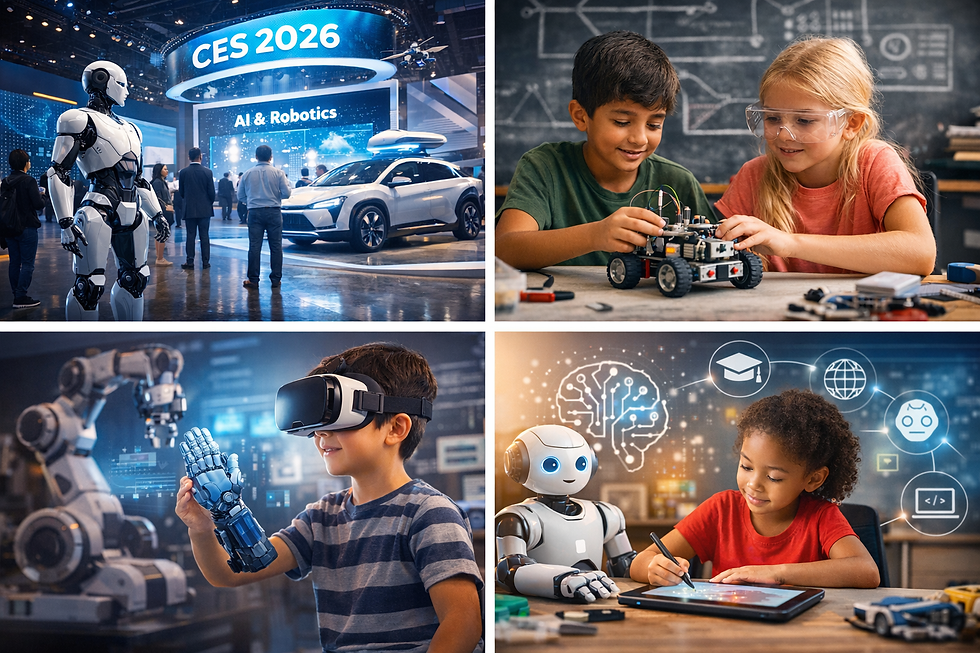
AI literacy in practice: students develop systems thinking and conceptual understanding by engaging with interactive digital and robotic design environments.
Artificial intelligence is no longer a futuristic concept reserved for researchers or engineers. It is becoming a daily tool—embedded in writing, communication, art, science, and even how we search for information. For today’s students, AI literacy is quickly becoming as essential as reading and writing.
AI literacy doesn’t mean “learning to build AI systems.” It means helping students understand how AI works, how to use it responsibly, and how to think critically about tools that shape their world.
For K–12 learners, AI literacy lays the foundation for stronger academics, problem-solving, and future-ready skills. Here’s why it matters.
I. Introduction: AI Is the New Language
In the same way digital literacy transformed education 20 years ago—AI literacy is now reshaping learning.
AI = reading, writing, and critical thinking of the future.
Students will increasingly read AI-generated text, respond to AI-supported prompts, and analyze AI-powered data. Understanding AI becomes part of understanding modern communication.
And importantly:
AI literacy ≠ coding AI.
Students don’t need to train deep learning models to be AI literate. But they do need to understand:
how AI makes decisions
what data it uses
what its limitations are
where bias may appear
how to use it safely and responsibly
This foundational understanding prepares students for every future academic environment.
II. AI Literacy = Understanding How Systems Think
AI literacy starts with a simple but powerful idea:
AI tools follow patterns—just like humans learn to.
Here are the essential concepts students learn:
1. What is a model?
A model is a system trained on examples to make predictions. Kids begin to understand:
why a tool writes a sentence
why it recognizes a picture
why it misinterprets something
2. Data → Prediction
AI learns patterns from data—just like children learn from experience.
Early understanding helps students think critically about:
whether the data is enough
whether predictions are reliable
whether sources are trustworthy
3. Fairness and Bias
Children quickly see:
If data is incomplete → results are unfair
If data is biased → outcomes are biased
This builds early ethical reasoning, something that all future learners will need.
III. Academic Benefits Across Subjects
AI literacy enhances—not replaces—traditional learning. Here’s how it strengthens major academic areas:
Math: Pattern Recognition
Students identify patterns and relationships:
why an algorithm groups similar items
how numbers or shapes repeat
how predictions are calculated
This boosts conceptual math understanding.
Science: Data Analysis
AI tools encourage questions like:
“What does the data show?”
“Is the prediction accurate?”
“What evidence supports this?”
Students become stronger scientific thinkers.
English: Summaries, Structure, Argument
AI literacy encourages deeper reading skills:
evaluating summaries
comparing different versions
understanding structure and tone
identifying poor reasoning
Students become more analytical—not more dependent.
Social Studies: Systems Thinking
Understanding AI helps students see how systems interact:
data → decision → consequence
how information spreads
how bias affects society
This builds sophisticated thinking that supports humanities and social sciences.
IV. AI Tools as “Amplifiers,” Not “Shortcuts”
One of the biggest fears parents have is:
“Will AI make my child lazy?”
The opposite is true—when students understand how AI works.
Students who are AI-literate:
ask better questions
use AI as a brainstorming partner
check for errors
rewrite and revise
verify information
think more critically
AI becomes a thinking amplifier, not a shortcut. And these students become independent, resourceful learners who can solve problems with and without AI tools.
V. Psychological & Executive Function Benefits
AI literacy strengthens core learning skills:
1. Planning
Students learn to structure tasks:
prompt planning
step-by-step instructions
organizing ideas
2. Research Skills
With AI as a guide (not an answer machine), students learn:
how to check sources
how to compare viewpoints
how to evaluate quality
3. Problem Analysis
Students break problems into pieces—just like AI systems do:
What is the question?
What information is needed?
How do we evaluate the response?
These skills carry over into writing, science fair projects, and everyday academic tasks.
VI. Portfolio & Competitions
As students grow older, AI literacy becomes a powerful academic tool.
AI Projects = Higher Rigor
Students can build:
classification models
computer vision demos
simple NLP projects
data-driven investigations
creative AI storytelling
These become portfolio artifacts that stand out.
Competitions & Fairs
AI literacy prepares students for:
WAICY
FLL Innovation
VEX IQ/V5 programming
WRO Future Innovators
science fairs
ISEF-track research projects
Understanding AI helps students compete at a higher level, with more clarity and creativity.
VII. Conclusion
AI literacy is not an optional skill. It is becoming the foundational literacy of this generation—just as digital literacy was 20 years ago.
Students who understand AI will not be replaced by AI.
They will be the ones who can:
ask better questions
think more critically
create more responsibly
innovate with confidence
At Future Lab Academy, we believe AI literacy allows children to thrive—not only in academics, but in a world where intelligent systems are everywhere.