Unlock Creativity — Why Scratch Animation Builds Early Computational Thinking
Updated: Dec 12, 2025
How animation nurtures storytelling, problem-solving, and AI-era readiness for K–5 learners.
Future Lab Academy Insights
In an era shaped by artificial intelligence, digital storytelling, and rapid technological transformation, creativity is no longer an optional enrichment—it has become a foundational form of literacy.
For young learners, especially in K–5, Scratch animation offers a uniquely powerful space where imagination, logic, and expression converge. Through visual storytelling and dynamic play, children develop early computational thinking in ways that feel intuitive, joyful, and deeply human.
Scratch, developed by MIT Media Lab’s Lifelong Kindergarten Group, is not simply a coding tool. It is a creativity engine—one that allows children to shape ideas, test hypotheses, and bring stories to life.
At Future Lab Academy, we view Scratch animation not as an “art activity,” but as a developmental framework that prepares young minds for robotics, coding, and eventually AI literacy.
The Importance of Scratch Animation for Early Computational Thinking
Young children learn best when they can explore, manipulate, and create. Scratch animation transforms natural curiosity into structured problem-solving, helping children develop the roots of computational thinking long before formal programming is introduced.
Animation requires sequencing, logic, decision-making, and prediction—all core components of computational thinking. When children animate a scene, they are not just creating art; they are constructing systems, exploring cause and effect, and understanding how parts interact within a whole.
How Animation Strengthens Cognitive Development
Sequencing as the Basis of Logic and Problem-Solving
Animation gently trains children to think in logical steps:
What happens first?
What comes next?
How does the scene change over time?
This mirrors the structure of programming and aligns closely with the development of executive function skills in early childhood.
Understanding Cause and Effect
When a sprite moves, speaks, or reacts, children immediately see the impact of their decisions. They naturally practice:
causal reasoning
prediction
debugging (Why didn’t it work?)
These are the earliest stages of computational thinking and scientific reasoning.
Storytelling as a Human Skill in an AI-Driven World
AI can now generate images, music, and text—but it cannot replace human intention, emotion, and narrative.
Through Scratch animation, children learn:
how to structure ideas
how to convey emotion
how to communicate a message
how to design meaningful stories
This becomes a core communication skill as students grow into future innovators and leaders.
Emotional Expression and Identity Building
Scratch provides children a safe, expressive medium where characters become mirrors of their inner world. Young learners can explore identity, emotions, imagination, and personal experiences—often expressing ideas they are not yet ready to articulate verbally.
Why Scratch Is the Ideal Platform for Young Creators
Block-Based Logic That Matches Cognitive Development
Scratch eliminates the frustration of syntax and frees mental bandwidth for:
creativity
structure
reasoning
expression
This is the essence of scratch animation computational thinking:children use computational ideas to create, not to memorize rules.
A Multi-Modal Creative Ecosystem
Scratch integrates:
visual design
animation
sound
narration
logic and math
design thinking
Few environments activate as many dimensions of cognition and creativity simultaneously.
A Global Community That Inspires Growth
With millions of projects shared worldwide, children learn by exploring, remixing, and building upon others’ ideas.This nurtures creativity, digital citizenship, and collaborative learning.
Learning Science Behind Scratch Animation
Constructionism: “Learning by Making”
MIT scholar Seymour Papert’s research shows that children learn best when they create public, meaningful artifacts.Scratch animation embodies this principle—every project becomes a personal achievement children feel proud to share.
Immediate Feedback Accelerates Learning
Clicking the green flag provides instant visual results.This reinforces:
rapid iteration
low-stakes experimentation
continuous improvement
An ideal cycle for early cognitive development.
Multisensory Thinking
Animation engages visual, auditory, spatial, and linguistic thinking simultaneously, supporting diverse learning styles.
Metacognition: Thinking About Thinking
As children debug their animation, they naturally reflect:
What did I try?
Why didn’t it work?
What should I adjust?
This is the beginning of metacognitive awareness—the hallmark of strong learners.
How Scratch Animation Prepares Students for Robotics and AI
Although Scratch feels playful, it lays the conceptual groundwork for advanced STEM pathways.
Computational Thinking Skills
Animation strengthens:
logic and conditions
loops and events
abstraction and decomposition
systems thinking
These skills map directly onto robotics behaviors, programming, and AI reasoning.
Visualizing Algorithms
Animation sequences help children understand how robots operate:
movement = actuators
events = sensors
timing = control systems
Scratch is essentially a pre-engineering visualization environment.
Resilience Through Debugging
When something doesn’t work, children learn to:
stay curious
try alternatives
embrace mistakes as part of learning
This mindset is essential for future scientists, engineers, and creators.
Design Thinking Mindset
Every animation inherently follows:
empathize
define
prototype
test
iterate
This mirrors professional engineering and innovation processes.
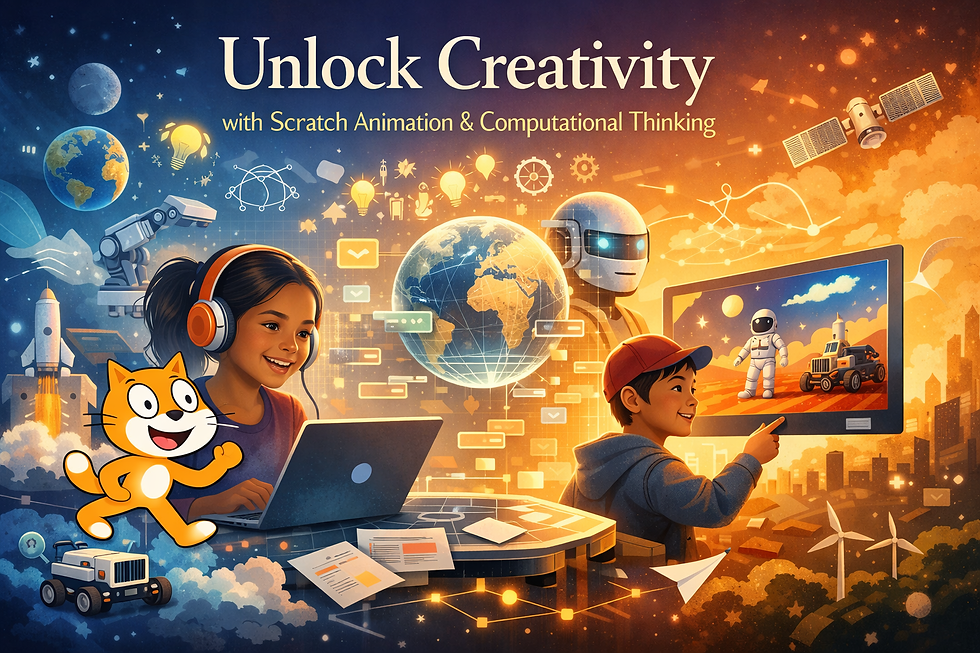
Classroom Example: “A Day on Mars”
In our K–5 Foundations program, students design an animated mission on Mars:
They create:
a rover
an explorer character
environmental challenges
objectives like collecting samples or navigating terrain
Students learn:
storyboarding
animation timing
loops and interactions
problem-solving
scientific reasoning
expressive storytelling
It is one of our most beloved interdisciplinary projects because it blends creativity with early STEM.
How Parents Can Support Creative Coding
Ask open-ended questions
Celebrate small ideas
Avoid over-helping
Watch projects together
Encourage remixing and exploration
Your role is not to teach coding—it is to nurture creativity.
Final Thoughts: Creativity Becomes Computational Power
Scratch animation is more than a creative outlet. It is:
a gateway to computational thinking
a training ground for storytelling
a foundation for robotics and AI
a joyful introduction to creative computing
a catalyst for confidence and curiosity
At Future Lab Academy, we believe creativity is the most powerful future skill. And every animation a child makes is a step toward that future.