Why Early Robotics Education Matters for K–5 Learners: Building the Cognitive and Creative Architecture for Tomorrow Future Lab Academy Insights

Updated: Dec 12, 2025
Future Lab Academy Insights

Around the world, education systems are quietly undergoing a profound shift. As technology accelerates and intelligent systems reshape every sector, one truth is emerging with increasing clarity:
The future belongs to children who can imagine, design, and build.
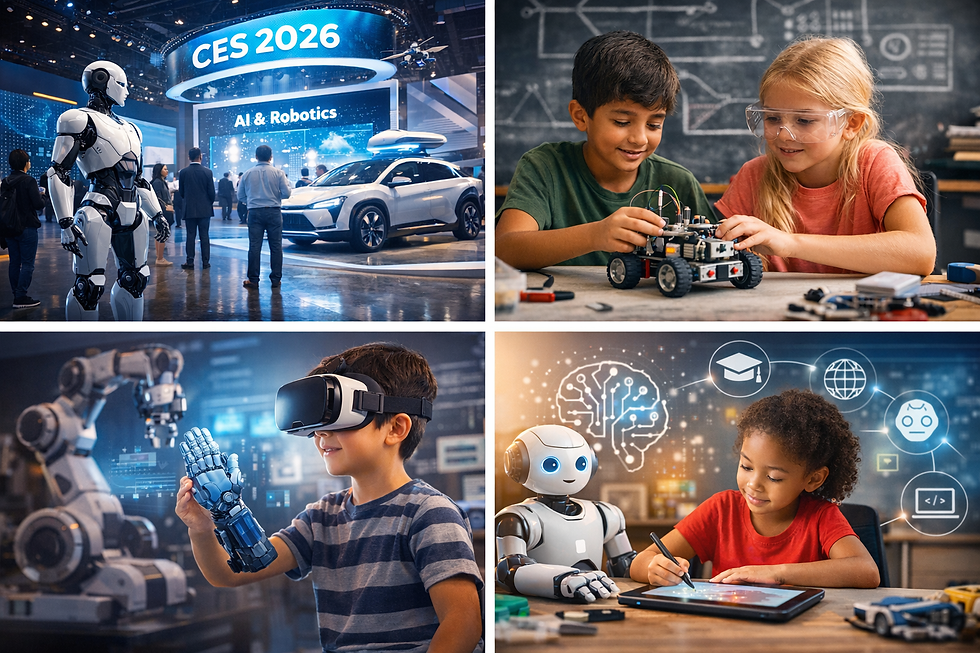
For K–5 learners, robotics is far more than an introduction to technology.It is an early apprenticeship in how the world works.
Not through worksheets.Not through memorization.But through creation, experimentation, and agency.
Early robotics education strengthens the cognitive, social, and emotional foundations that children will rely on for the rest of their lives. Below, we explore why this early exposure matters—and how it shapes a generation ready not only to use technology, but to shape it.
The Importance of Early Robotics Education for K–5 Learners
Children learn through action. Neuroscience confirms that young learners develop deeper understanding when they manipulate, test, revise, and physically engage with their environment.
Early robotics transforms abstract ideas—sequence, cause and effect, logic, structure—into something young minds can touch.
This early embodiment of engineering thinking has measurable benefits:
stronger executive function
increased working memory
deeper conceptual understanding
significantly higher long-term engagement in STEM
Just as early reading builds the architecture for literacy, early robotics builds the architecture for technological fluency.
Robotics as a Catalyst for Creative and Divergent Thinking
Robotics is often misunderstood as purely technical.In reality, it is one of the most powerful drivers of creativity.
Imagination Becomes Engineering
For a child, the moment a self-built robot moves is transformative.An idea—once intangible—has become real.
This shift is profound:children internalize the belief that their ideas hold power.
Failure Becomes Exploration
In robotics, iteration is celebrated.A mistake is not a flaw—it is a data point.
This nurtures creative confidence: the ability to ask bold questions, tolerate ambiguity, and explore unconventional solutions. These habits of mind are central to future innovation.
Robotics Builds Early Problem-Solving Muscles
Problem-solving is not a skill learned in theory—it is a discipline cultivated through practice.
Early robotics gives children a structured yet playful environment to:
test hypotheses
debug systems
refine sequences
analyze outcomes
design alternative pathways
From Intuition to Logic
K–5 learners naturally experiment. Robotics channels this playfulness into systematic thinking—one of the foundational competencies of mathematics, engineering, and computer science.
Young learners begin to understand:
why something worked
why something didn’t
what can be improved
how to design better solutions
This is early engineering in its purest form.
Confidence, Agency, and Resilience
Robotics offers one of the earliest experiences of technical agency—the sense that “I can build something meaningful.”
Small Wins → Strong Identity
When a robot successfully completes a task, even a simple one, children experience mastery that strengthens:
self-efficacy
intrinsic motivation
perseverance
ownership over learning
They begin to view challenges not as obstacles, but as puzzles.
Resilience Through Iteration
Children learn that progress is iterative—not linear.In an age dominated by instant gratification, this slow and thoughtful pathway to mastery becomes a lifelong advantage.
The Social Architecture of Robotics: Communication, Collaboration, Leadership
Robotics is rarely a solitary activity.It inherently cultivates social competencies that are crucial in modern learning and work environments.
Shared Goals, Shared Thinking
Through team building:
children articulate ideas
negotiate roles
reconcile differing viewpoints
build emotional intelligence
practice empathy and listening
These are not “soft skills.”They are the infrastructure of leadership.
A Launchpad for Future STEM Pathways
Early robotics is a gateway, not a destination.
When students build confidence in K–5, they develop the cognitive flexibility and problem-solving habits that prepare them for more advanced STEM learning later on. Whether they choose engineering, coding, AI, research, or innovation projects in the future, early robotics ensures they step into those experiences with confidence—never intimidation.
Conclusion: Building the Builders of Tomorrow
Robotics is not about teaching children to work with machines.It is about teaching them to think, design, and innovate.
K–5 learners who engage in early robotics develop:
intellectual courage
creative resilience
systematic reasoning
collaborative competence
confidence in their ability to shape the world
These are not skills for the future. They are skills for now.
At Future Lab Academy, we believe that every child deserves the opportunity to discover the joy of building—early, boldly, and with purpose.
Because when children build early, they build a different future.