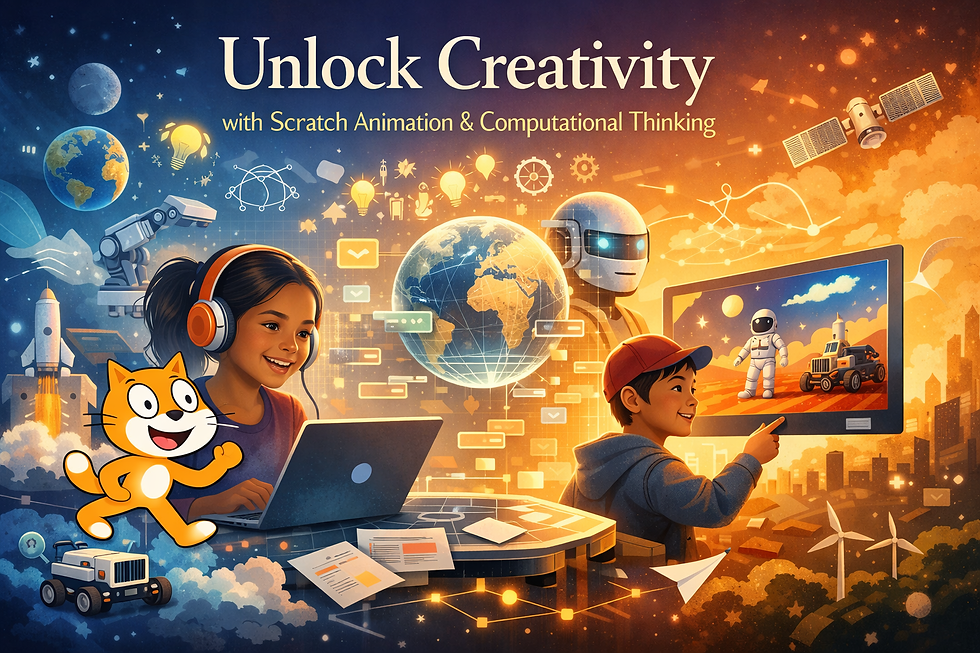
Scratch vs Python: Which Should Kids Learn First?
—— A Developmental Framework for Young Creators in the Age of AI
Future Lab Academy Insights

As artificial intelligence, autonomous systems, and digital creation increasingly shape the modern world, parents and educators often ask a seemingly simple question:
Should children begin their learning journey with visual programming, or should they move directly into text-based programming languages such as Python?
While this question is commonly framed as a comparison between tools, it is, in fact, a question about how children think, grow, and develop intellectually. Visual programming and text-based programming are not competing choices. They represent distinct stages in a child’s cognitive and computational development.
At Future Lab Academy, we approach this decision through a developmental lens. The goal is not acceleration, but alignment—ensuring that the learning environment matches the learner’s readiness at each stage.
Learning Computing as a Developmental Process
Children do not acquire computational thinking in the same way adults acquire technical skills. Early learners construct understanding through concrete interaction, visual feedback, experimentation, and storytelling. Abstract symbols and formal syntax become meaningful only after these foundations are in place.
Research in developmental psychology and learning science consistently demonstrates that effective learning progresses from concrete representation to abstract reasoning. When instruction respects this progression, learners build deeper understanding, greater confidence, and stronger long-term capability.
The essential question, therefore, is not which language is superior, but which form of thinking a child is developmentally prepared to engage with.
Early Stages: Visual Creative Coding and Foundational Thinking
For young learners, particularly in the early elementary years, the primary objective is the development of computational thinking, not the mastery of syntax.
Visual creative coding environments support this goal by enabling children to:
sequence actions and events
reason about cause and effect
decompose complex ideas into manageable steps
test hypotheses through immediate visual feedback
express logic through storytelling and design
At this stage, children learn how systems behave rather than how commands are written. Technology becomes something they can shape and explore, rather than something to be memorized or feared.
Crucially, this approach preserves intrinsic motivation. Curiosity, imagination, and confidence remain central to the learning experience—qualities that are often diminished when abstraction is introduced prematurely.
Bridging Logic and the Physical World Through Robotics
As learners mature, hands-on robotics systems provide an important transition. Logic moves beyond the screen and begins to influence physical behavior—movement, response, and interaction with the environment.
Through this stage, students deepen their understanding of:
systems thinking and feedback loops
applied problem-solving
debugging as a normal and valuable process
collaboration and shared responsibility
the relationship between design choices and outcomes
Robotics grounds abstract ideas in tangible experience. It strengthens computational thinking by making cause and effect visible and concrete, while preparing students for more formal engineering concepts.
Advancing Toward Text-Based Programming and Abstraction
Text-based programming languages introduce a new level of cognitive demand. Learners must engage with symbolic representation, precise syntax, sustained attention, and delayed feedback.
For most students, this transition becomes appropriate when abstract reasoning skills begin to consolidate—typically in late elementary or early middle school. When introduced at the right time, text-based programming enables learners to:
structure complex algorithms
manage data and logic systematically
engage with engineering-oriented problem solving
build the foundations for advanced computational work
Students who arrive at this stage with strong visual and hands-on foundations adapt more efficiently and with greater confidence. They approach abstraction as a natural extension of prior understanding rather than as an intimidating leap.
Advanced Learning: AI-Enabled Systems and Complex Problem Solving
At more advanced stages, learners begin working with AI-enabled autonomous systems and vision-based technologies. Programming evolves from isolated instructions into integrated systems that involve perception, decision-making, optimization, and ethical consideration.
Here, students apply accumulated skills to open-ended challenges that resemble real-world engineering and research contexts. The emphasis shifts from speed to depth—understanding not only how systems function, but why they behave as they do.
A Common Misconception: Skipping Foundational Stages
A frequent concern among parents is that beginning with visual or hands-on environments may slow a child’s progress. In practice, the opposite is true.
Students who bypass foundational stages often encounter difficulties later, including frustration with abstraction, diminished confidence, and a perception of programming as rigid or inaccessible. By contrast, learners who progress through a developmentally aligned sequence demonstrate stronger conceptual understanding, greater resilience, and more creative problem-solving habits.
Foundations do not delay advancement. They enable mastery.
A Developmentally Appropriate Starting Point
The appropriate starting point for learning programming is not defined by a specific language, but by a sequence of cognitive readiness.
Children benefit most when they begin with learning environments that align with how they think at each stage of development, allowing complexity to emerge gradually rather than being imposed prematurely.
A well-designed progression moves from visual creative coding, to hands-on robotics systems, to text-based programming, and ultimately to AI-enabled autonomous systems. This pathway supports sustained engagement, intellectual growth, and long-term capability.
Conclusion: Educating Thinkers, Not Just Coders
In the age of artificial intelligence, the most valuable skill is not familiarity with a particular programming language. It is the ability to think clearly, adapt to complexity, and create with intention.
When children are given the right learning environments at the right time, they do more than learn to code. They develop confidence, curiosity, and the capacity to shape technology rather than be shaped by it.
Visual and text-based programming are not alternatives. Together, they form a coherent developmental journey—one that prepares young learners not only to participate in the future, but to help design it.
Considering the Right Learning Path for Your Child
Every child develops differently. What matters most is not how early they start, but how well their learning journey aligns with who they are becoming.
At Future Lab Academy, we work closely with families to understand each child’s readiness, interests, and learning style—then design a personalized pathway that supports confidence, creativity, and long-term growth in robotics, coding, and AI.
If you are exploring how to guide your child’s next step in computational learning, we invite you to start a conversation.
Explore Our Learning Pathways →