From CES 2026 to the Classroom: Why AI and Robotics Matter for Kids

Future Lab Academy Insights
CES 2026 as a Signal, Not a Headline
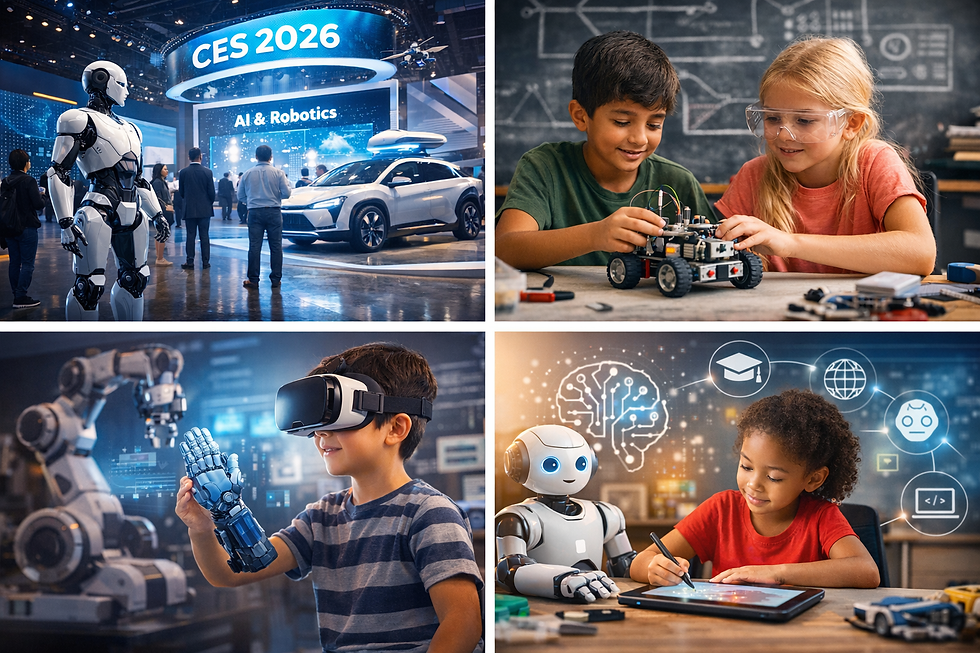
At CES 2026 in Las Vegas, a clear signal emerged across industries: artificial intelligence is no longer confined to screens, and robotics is no longer experimental. Intelligent systems are beginning to perceive, decide, and act in the physical world.
Rather than introducing isolated devices or novelty features, the exhibition reflected a broader structural shift. AI is becoming embedded in autonomous systems, robotics is integrating sensing and decision-making, and technology is increasingly designed to operate in dynamic, real-world environments.
CES 2026 matters not because of any single product announcement, but because it offers a concentrated glimpse into where technology is heading—and, by extension, what kinds of thinking future generations will need to navigate it.
Beyond Devices: What Is Actually Changing
The most important trends visible at CES 2026 were not about faster processors or smarter interfaces. They revealed deeper changes in how technology is designed and deployed.
First, AI is moving from abstract computation toward embodied intelligence. Systems are no longer optimized solely for prediction or classification; they are being built to interact with physical environments, adapt to uncertainty, and respond in real time.
Second, robotics is shifting from isolated tasks toward coordinated systems. Modern robots integrate perception, reasoning, and action, requiring designers and engineers to think in terms of feedback loops, system behavior, and interaction rather than linear commands.
Third, intelligence is increasingly defined by integration. Sensing, decision-making, and execution are no longer separate components but interdependent processes. Understanding how these systems behave requires systems thinking, experimentation, and iterative problem-solving.
These trends point toward a future shaped less by discrete tools and more by complex, interconnected systems.
The Educational Question Behind the Technology
When technology evolves in this way, the central educational question is not which tools children should learn, but what kinds of thinking they need to develop. Future learners will need to understand systems rather than interfaces, logic rather than instructions, and behavior rather than appearances. They will need to reason about cause and effect, manage complexity, and adapt to changing conditions. This shifts the focus of education away from early technical acceleration and toward cognitive readiness. The question becomes not “How early can a child code?” but “What learning experiences help a child grow into this kind of thinking?”
Learning Computing as a Developmental Process
Children do not acquire computational thinking in the same way adults acquire technical skills. Cognitive development unfolds gradually, moving from concrete interaction to abstract reasoning.
Early learners build understanding through visual feedback, physical manipulation, experimentation, and storytelling. Abstract symbols and formal syntax only become meaningful once these foundations are in place.
Research in developmental psychology and learning science consistently shows that effective learning progresses from concrete representation to abstraction. When instruction respects this progression, learners develop deeper understanding, stronger confidence, and greater long-term capability.
When this progression is ignored, learning can feel opaque, frustrating, or disconnected from meaning.
From Visual to Text-Based Programming: A Matter of Timing
Visual programming environments play a critical role in early learning because they allow children to focus on logic and structure without the cognitive burden of syntax. Through visual coding, children learn to sequence actions, reason about cause and effect, decompose complex ideas, and test hypotheses through immediate feedback.
As learners mature, hands-on robotics systems provide an essential bridge. Logic moves beyond the screen and begins to influence physical behavior—movement, sensing, and interaction with the environment. Robotics grounds abstract ideas in tangible experience, reinforcing systems thinking and problem-solving through iteration and debugging.
Text-based programming introduces a higher level of abstraction. Learners must manage symbolic representation, precise syntax, and delayed feedback. When introduced at the right stage—typically in late elementary or early middle school—text-based programming becomes a natural extension of prior understanding rather than an intimidating leap.
These approaches are not alternatives. They represent distinct stages in a coherent developmental sequence.
Why Robotics Matters in an AI-Driven World
In an era of embodied AI and autonomous systems, robotics is no longer a niche educational activity. It is a powerful learning medium that connects abstract computation with real-world behavior.
Robotics allows learners to observe how systems respond to inputs, how design decisions affect outcomes, and how errors become opportunities for refinement. It makes complexity visible and invites experimentation.
This aligns closely with the technological direction highlighted at CES 2026, where intelligent systems are expected to operate in physical, unpredictable environments. Robotics education prepares students not just to use technology, but to understand how intelligent systems function as integrated wholes.
Preparing Children for an AI-Shaped Future
As AI and robotics become foundational technologies, the most valuable skills are not tied to any specific language or platform. They include:
Systems thinking and holistic reasoning
Iterative problem-solving and resilience
The ability to test, refine, and adapt ideas
An understanding of how intelligent systems behave
Ethical awareness and responsibility in design
These capacities cannot be rushed. They are cultivated through carefully designed learning experiences that respect how children grow.
A Thoughtful Learning Path, Not Acceleration
One common misconception is that starting earlier or moving faster guarantees better outcomes. In practice, premature abstraction often undermines confidence and long-term engagement.
A developmentally aligned learning path allows complexity to emerge gradually. It moves from visual creative coding, to hands-on robotics systems, to text-based programming, and ultimately to AI-enabled autonomous systems.
Such a pathway supports sustained curiosity, intellectual growth, and a sense of agency. Foundations do not delay mastery—they enable it.
From CES to the Classroom
CES 2026 offers a glimpse into the future of technology, but classrooms are where the future of learners is shaped.
When educational environments align with cognitive development, children do more than learn technical skills. They develop confidence, curiosity, and the ability to shape technology rather than be shaped by it.
Visual coding, robotics, and text-based programming are not competing choices. Together, they form a developmental journey—one that prepares children to engage thoughtfully and creatively with an AI-driven world.
Considering the Right Learning Path for Your Child
Every child develops differently. What matters most is not how early they start, but how well their learning journey aligns with who they are becoming.
At Future Lab Academy, we work closely with families to understand each learner’s readiness, interests, and learning style, then design personalized pathways that support long-term growth in robotics, coding, and AI.
If you are exploring how to guide your child’s next step in computational learning, we invite you to start a conversation.
Explore Our Learning Pathways →